
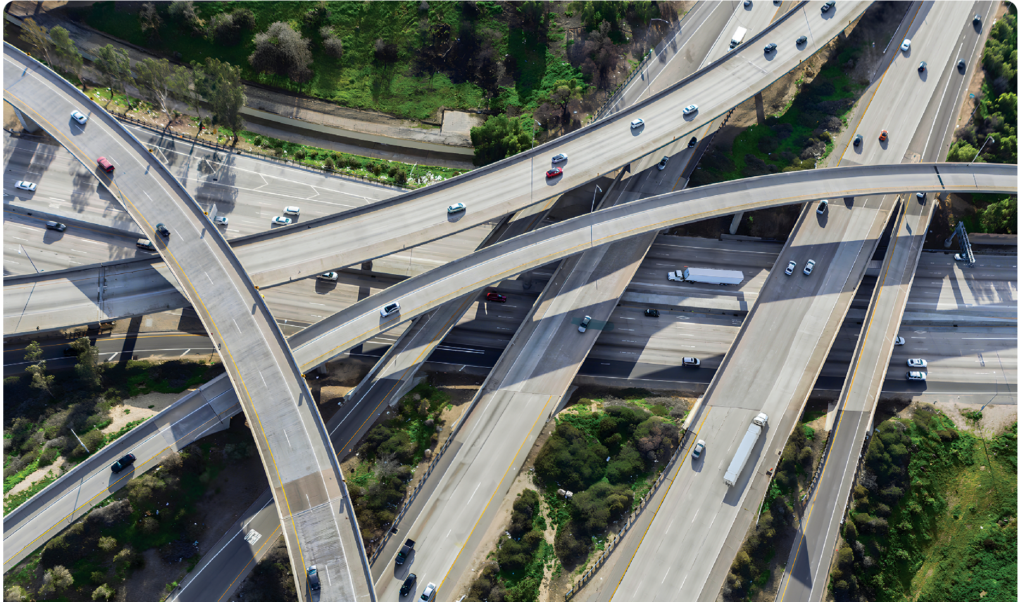
Smart roadways are highway corridors where sensors, traffic data feeds, and connected-vehicle networks are used to send real-time safety information directly to drivers — including into the cabs of commercial trucks. Instead of relying only on fixed signs and overhead message boards, a smart roadway delivers location-specific warnings about slowdowns, work zones, curves, and roadside incidents at the moment a driver needs them.
For commercial fleets, this is a meaningful shift. Highway safety messaging has historically been designed around passenger vehicles, and much of it never reaches a truck driver in time to matter. Smart roadway programs close that gap by treating the truck cab as a delivery channel.
How Do Smart Roadways Work?
Smart roadways work by combining three layers: data collection, a decision layer, and a delivery channel into the vehicle.
- Data collection. Roadside sensors, connected-vehicle telemetry, probe traffic data, agency incident feeds, and work zone management systems report what is happening on a given segment of road.
- Decision layer. Software evaluates that data against geofenced trigger zones — a sharp curve, a queue forming ahead, an active lane closure — and decides which vehicles need to be warned.
- Delivery. The alert is pushed to the vehicle. For commercial trucks, that can mean an in-cab visual message with an audible chime, delivered through the telematics device, ELD, tablet, or smartphone the driver already uses.
The critical design constraint is timing. An alert is only useful if it arrives far enough ahead of the hazard that the driver can act, depending on speed and stopping distance for a loaded truck.
How Do Smart Roadways Improve Highway Safety for Trucking Corridors?
Smart roadways improve highway safety for trucking corridors by giving drivers advance warning of hazards they cannot yet see, which changes speed and following behavior before a conflict develops. The measurable effects show up in three crash types that disproportionately involve heavy vehicles.
Rear-end collisions in sudden queues. A loaded tractor-trailer needs substantially more stopping distance than a passenger car, so a truck arriving at the back of an unexpected traffic queue at highway speed is a high-severity crash scenario. Rear point of impact was recorded in 19.1% of large trucks involved in fatal crashes in 2021, according to FMCSA crash data. Slowdown alerts target exactly this sequence.
Work zone and roadside worker exposure. Fatal work zone crashes involving a large truck or bus rose 41% between 2020 and 2021, per FMCSA work zone statistics. Advance lane closure and work zone notifications give drivers time to merge early rather than late.
Rollovers on curves and ramps. Trucks have a high center of gravity, and advisory speeds on ramps are frequently lower than the posted highway speed. An in-cab curve warning addresses a risk that a static sign often fails to convey with enough urgency.
Do In-Cab Safety Alerts Actually Change Driver Behavior?
In-cab safety alerts do change driver behavior, and the effect has been measured in state-run deployments. In previous smart roadway deployments, research cited by Drivewyze found that 25% of drivers slow down within 30 seconds of receiving an alert.
The most detailed public result comes from a Pennsylvania Turnpike program. Working with Drivewyze, the Turnpike delivered more than 70,000 in-cab safety notifications to truck drivers in the first six months, covering 32 curves and ramps along the 360-mile toll road. Drivers who received notifications:
- Reduced speed 7% more than drivers who received no alert
- Recorded 17% fewer instances of excessive speed
- Experienced 12% lower lateral forces — the forces that drive rollover risk on curves
Those are behavioral outcomes an agency can audit, which is part of why smart roadway programs have spread. Agencies can monitor changes in speed and hard-braking events among alerted drivers and evaluate whether a safety campaign worked.
What Is the Difference Between Smart Roadways and Traditional Intelligent Transportation Systems?
The difference is where the message ends up. Traditional intelligent transportation systems (ITS) — dynamic message signs, ramp meters, roadside cameras, highway advisory radio — broadcast to whoever happens to be looking at the right place at the right time. Smart roadways are targeted: the alert is tied to a specific geofenced zone and delivered inside a specific vehicle.
| Attribute | Traditional ITS | Smart roadways |
|---|---|---|
| Delivery method | Fixed roadside signs, radio, cameras | In-cab message on the driver’s existing device |
| Targeting | Broadcast to all traffic in view | Geofenced, vehicle-class specific |
| Commercial vehicle reach | Incidental | Direct to commercial trucks |
| Capital cost per mile | High — physical installation | Low — software and data integration |
| Time to deploy a new alert zone | Weeks to months | Hours to days |
| Effectiveness measurement | Traffic counts, spot speed studies | Per-alert speed and hard-braking response |
Smart roadways do not replace physical ITS infrastructure. They extend it, and they let an agency cover corridors where installing new gantries or sign structures is not financially realistic.
How Do Smart Roadways Relate to V2X and Connected Vehicle Technology?
Smart roadways and V2X (vehicle-to-everything communication) solve the same problem on different timelines. V2X refers to direct radio communication between vehicles, roadside units, and other road users. The Federal Communications Commission adopted final C-V2X rules for the upper 5.9 GHz band (5.895–5.925 GHz) in November 2024, with the rules taking effect in February 2025, and legacy DSRC roadside units sunsetting on December 14, 2026. Industry roadmaps expect V2X technology to begin reaching commercial vehicle models at scale in the 2026–2029 timeframe.
That transition matters, but it is a fleet-replacement-cycle timeline. Commercial trucks stay in service for a decade or more, and roadside unit coverage is still concentrated in funded corridors — the U.S. Department of Transportation’s national V2X deployment plan, released in August 2024, was followed by $60 million in grants to advance deployments in Arizona, Texas, and Utah.
Smart roadway services deliver the same class of safety message today, over cellular, to trucks already running telematics hardware. The two approaches are complementary: cellular-delivered alerts provide near-term corridor coverage, and direct C-V2X adds low-latency communication as the hardware base matures.
Which States Use Smart Roadway Alerts for Commercial Vehicles?
Twenty states currently use Drivewyze Smart Roadways services to send safety messages to commercial drivers, with California, Michigan, and Nevada among the more recent additions and Delaware joining through a partnership with DelDOT.
Adoption has accelerated. In 2024, monthly alert volume grew 151% year over year, and the average number of unique trucks receiving alerts grew 96%. State agencies also use the same channel for virtual signage — deploying temporary messages for major events, seasonal conditions, or quarterly safety campaigns without installing physical infrastructure.
What Does a Fleet Need to Receive Smart Roadway Alerts?
A fleet needs a connected in-cab device and a service subscription — not new hardware installed on the truck. Alerts are delivered through telematics platforms, ELDs, tablets, or smartphones that fleets already operate.
Three practical considerations for fleet safety and operations leaders:
- Confirm platform compatibility. Check whether your telematics or ELD provider already integrates smart roadway alerting, since many do.
- Decide who sees the data. Alert response data — speed change, hard braking — can feed coaching programs, but only if safety managers can access it.
- Evaluate cost tiers. Drivewyze offers a set of in-cab safety alerts, including slowdown and virtual sign messaging, at no cost through Drivewyze Free, with expanded services available in paid tiers.
What Comes Next for Connected Trucking Corridors?
Expect three developments through 2026 and 2027: broader work zone data integration as agencies digitize lane closure records, wider state participation as the cost of adding a corridor stays low, and gradual overlay of direct C-V2X communication as compliant vehicles and roadside units come online.
For fleet leaders, the practical takeaway is that corridor safety information is now a data feed rather than a piece of roadside furniture. The fleets that benefit are the ones that make sure the feed reaches the cab — and that they are looking at what drivers do after the alert arrives.
What are smart roadways?
Smart roadways are highway corridors that use sensors, traffic data, and connected-vehicle networks to send real-time safety alerts directly to drivers. For commercial trucking, alerts appear as in-cab messages warning of slowdowns, work zones, sharp curves, and roadside incidents ahead, delivered through telematics devices, ELDs, tablets, or smartphones.
How do smart roadways improve trucking safety?
Smart roadways improve trucking safety by warning drivers of hazards before they are visible. Advance notice reduces rear-end collisions in sudden traffic queues, protects work zone crews by prompting earlier merges, and lowers rollover risk on curves. Measured deployments show drivers reduce speed and hard braking after receiving alerts.
Are smart roadway alerts the same as V2X?
No. V2X is direct radio communication between vehicles and roadside units in the 5.9 GHz band, governed by FCC rules that took effect in February 2025. Smart roadway services deliver comparable safety messages today over cellular networks to trucks already running telematics hardware. The two approaches are complementary.
How many states use smart roadway alerts for trucks?
Twenty states currently use Drivewyze Smart Roadways to send safety alerts to commercial drivers, including recent additions California, Michigan, Nevada, and Delaware. Adoption grew sharply in 2024, with monthly alert volume up 151% and unique trucks receiving alerts up 96% year over year.
Do truck drivers actually respond to in-cab alerts?
Yes. Research cited by Drivewyze found 25% of drivers slow down within 30 seconds of an alert. In a Pennsylvania Turnpike deployment covering 32 curves and ramps, alerted drivers reduced speed 7% more than unalerted drivers, recorded 17% fewer excessive-speed events, and experienced 12% lower lateral forces.
What does a fleet need to start receiving smart roadway alerts?
A fleet needs a connected in-cab device — a telematics unit, ELD, tablet, or smartphone — and a compatible service. No new truck hardware is required. Drivewyze Free provides a set of in-cab safety alerts, including slowdown warnings and virtual sign messaging, at no cost to fleets and owner-operators.